Facing a tenant who won't pay rent, damages your property, or refuses to leave when the lease ends is one of the most stressful situations a landlord can encounter. You want your property back, but you also need to protect yourself from serious legal consequences. This guide explains exactly how to evict a tenant in South Africa lawfully, what the process involves, and how to avoid the costly mistakes that can land you in criminal court.
The PIE Act and Your Rights as a Landlord
Under South African law, eviction is strictly regulated. Section 26 of the Constitution enshrines the right to adequate housing, which means no person may be evicted from their home without a court order. The Prevention of Illegal Eviction from and Unlawful Occupation of Land Act 19 of 1998 (PIE Act) gives effect to this constitutional protection.
The PIE Act requires landlords to follow due legal process before removing any tenant or occupier, regardless of whether they have a written lease, whether they are paying rent, or whether the lease has expired. Section 4 of the PIE Act makes it a criminal offence to evict anyone without a court order.
This means you cannot change locks, cut off water or electricity, remove belongings, or intimidate a tenant into leaving. The penalty for illegal eviction is severe: imprisonment of up to two years, substantial fines, and potential civil liability for damages.
In our experience handling eviction matters in Paarl Magistrate's Court and Cape Town High Court, we have seen landlords face costly delays, damage claims, and even criminal prosecution simply because they tried to take matters into their own hands. Following the correct procedure is not optional; it is the only lawful path to regaining possession of your property.
When You Can Legally Evict a Tenant in South Africa
Eviction is only justified when there are valid legal grounds. The most common reasons landlords seek eviction include:
Non-Payment of Rent
Non-payment of rent is a material breach of the lease agreement and the most frequent ground for eviction. If your tenant consistently pays late, skips months entirely, or stops paying altogether, you have grounds to cancel the lease and seek an eviction order.
Lease Expiry Without Renewal
When a fixed-term lease reaches its end date and the tenant refuses to vacate, eviction proceedings become necessary. This also applies when buying a house with existing tenants whose lease has expired. The tenant no longer has a legal right to occupy the property once the lease term expires and has not been extended.
Breach of Lease Terms
Tenants who breach material terms of the lease, such as subletting without permission, keeping unauthorised pets, causing intentional damage to the property, or engaging in illegal activity on the premises, can be evicted.
Property Damage Beyond Normal Wear and Tear
While tenants are not liable for normal wear and tear, they are responsible for intentional or negligent damage. Significant property damage that affects the habitability or value of the property constitutes grounds for eviction.
In all these situations, the breach must be material, not trivial. Courts will assess whether the breach is serious enough to justify removing someone from their home.
How to Evict a Tenant in South Africa: The Step-by-Step Process
The eviction process in South Africa follows a structured sequence. Skipping steps or failing to comply with notice requirements can void your eviction and force you to start again.
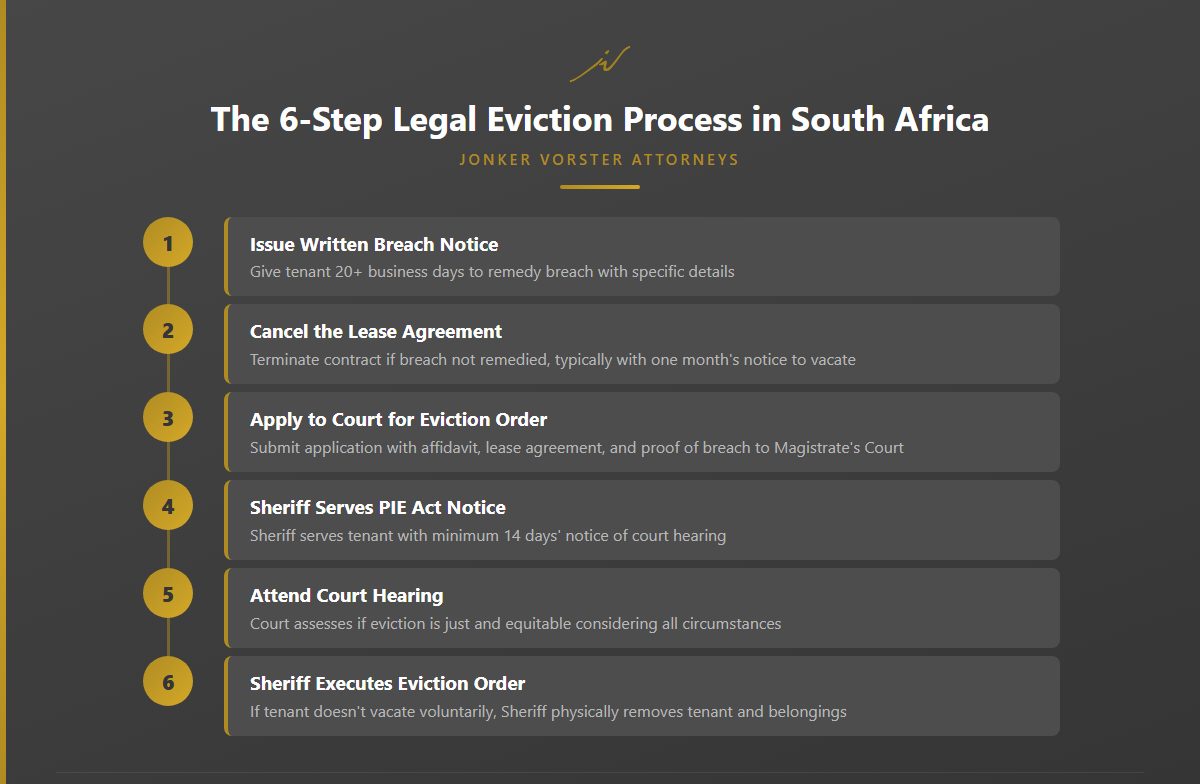
Step 1: Issue a Written Breach Notice
The first formal step is serving the tenant with a written breach notice, also known as a notice of default. This notice must clearly state:
- The specific breach (for example, unpaid rent for February and March)
- The remedy required (for example, payment of R24,000 in arrears)
- A reasonable timeframe for the tenant to remedy the breach
The Consumer Protection Act 68 of 2008 requires that you give the tenant at least 20 business days to correct the breach. This notice period is mandatory, and failure to allow sufficient time will invalidate your cancellation.
The notice must be in writing. While email is acceptable if the lease agreement permits electronic communication, we recommend using registered mail or having the notice hand-delivered to the tenant's domicilium address with proof of receipt. In matters we have handled across the Cape Winelands, disputes about whether notice was properly served are among the most common delays.
Step 2: Cancel the Lease Agreement
If the tenant fails to remedy the breach within the notice period, you can proceed to cancel the lease. Lease cancellation is distinct from eviction. Cancellation terminates the contractual relationship; eviction is the court-ordered physical removal if the tenant refuses to leave voluntarily.
Your cancellation notice should state:
- That the lease is cancelled due to the tenant's failure to remedy the breach
- The date by which the tenant must vacate the property
- That legal proceedings will follow if the tenant does not vacate
Courts typically expect landlords to give tenants one month's notice to vacate after lease cancellation, although this can vary depending on circumstances.
Step 3: Apply to Court for an Eviction Order
If the tenant does not vacate by the date specified in your cancellation notice, you must apply to court for an eviction order. In the Western Cape, residential evictions are generally heard in the Magistrate's Court that has jurisdiction over the property, such as Paarl Magistrate's Court for properties in Paarl, or Cape Town Magistrate's Court for properties in Cape Town.
Your court application will include:
- The founding affidavit setting out the facts, the lease agreement, proof of breach, and copies of all notices served
- The lease agreement
- Proof of service of the breach notice and cancellation notice
- Evidence of the breach (for example, bank statements showing non-payment, photographs of damage)
- A draft eviction order
The application must comply with the Rules of Court and include all necessary documentation. Errors or omissions at this stage cause significant delays.
Step 4: Service of PIE Act Notice by the Sheriff
Once the court accepts your application, the Sheriff of the Court must serve the PIE Act notice on the tenant and, in certain circumstances, the municipality. This notice informs the tenant of the court hearing and gives them the opportunity to oppose the eviction.
Section 4(2) of the PIE Act requires at least 14 days' notice before the hearing date. The notice must be served in a manner that brings it to the tenant's attention.
Municipal notice is required where the property falls within a municipal area and the municipality may have an interest in the eviction. For properties in Paarl, Stellenbosch, Wellington, and Franschhoek, the relevant municipalities (Drakenstein and Stellenbosch) must often be notified.
Sheriff service is critical. If the Sheriff cannot serve the notice personally, alternative means (such as affixing the notice to the property and sending a copy by registered mail) may be used, but these must comply strictly with the Rules.
Step 5: Court Hearing and the "Just and Equitable" Test
At the hearing, the court will consider whether it is just and equitable to grant the eviction order. This is not a rubber-stamp process. Even if the tenant is in breach, the court must balance your right to possession against the tenant's constitutional right to housing.
Factors the court considers include:
- The extent and seriousness of the breach
- Whether the tenant had a reasonable opportunity to remedy the breach
- The personal circumstances of the tenant, including vulnerability (children, elderly persons, disabled persons)
- The availability of alternative accommodation
- The length of time the tenant has occupied the property
- Whether the tenant has anywhere else to go
If the tenant opposes the eviction, they may file an answering affidavit setting out their defence. Common defences include disputing the breach, claiming the notice was insufficient, or arguing that eviction would cause undue hardship.
In contested matters, the court may set the matter down for trial, where both parties can present evidence and call witnesses. This significantly extends the timeline.
Step 6: Eviction Order and Sheriff Execution
If the court is satisfied that eviction is just and equitable, it will grant an eviction order. The order typically gives the tenant a final period (often 30 days) to vacate the property voluntarily.
If the tenant still refuses to leave, the landlord can request the Sheriff to execute the eviction order. The Sheriff will physically remove the tenant and their belongings from the property and place them at the kerb. You may need to arrange for storage of belongings or disposal in accordance with legal requirements.
At this stage, the eviction is complete, and you regain lawful possession of your property.
Notice Requirements and Timelines Under the PIE Act
Understanding notice requirements and realistic timelines is essential for managing expectations.
Breach Notice Timeline
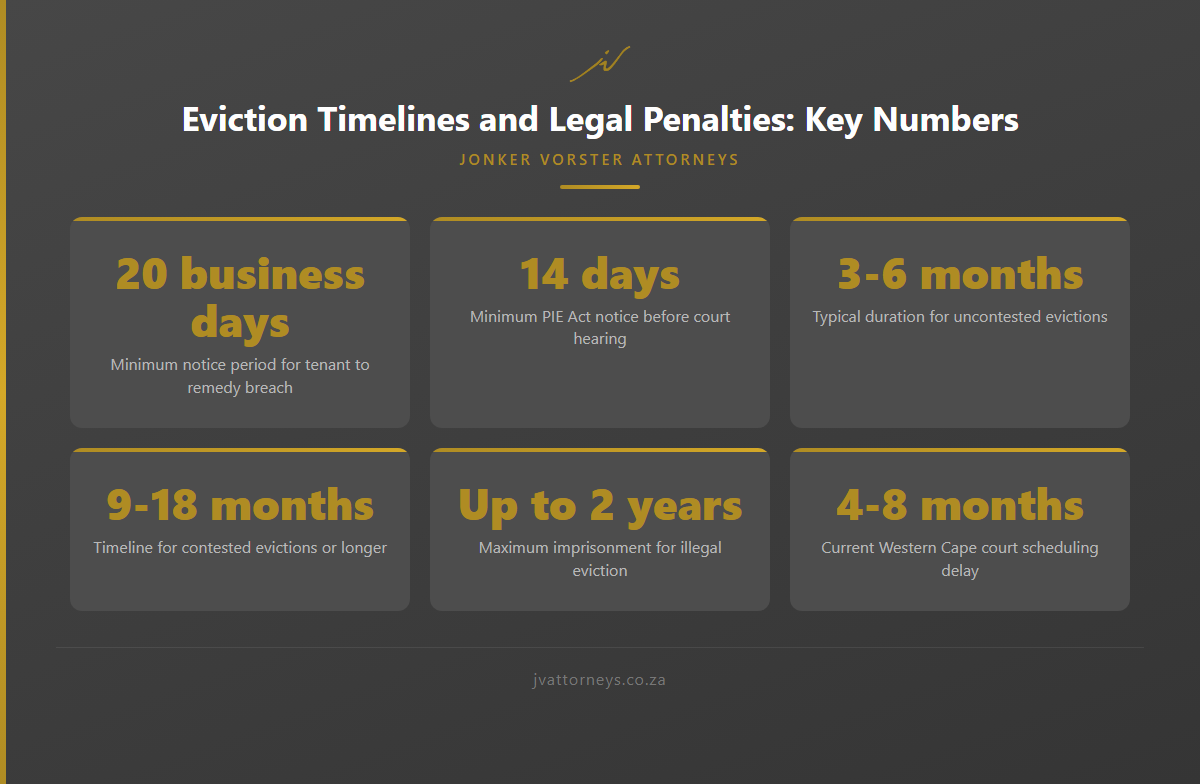
- 20 business days minimum for tenant to remedy the breach (Consumer Protection Act requirement)
- Additional time if the breach is complex or requires significant action
Lease Cancellation Timeline
- Typically one month's notice to vacate after cancellation, though this depends on the lease terms and circumstances
Court Application and Hearing Timeline
- 14 days' minimum PIE Act notice before the hearing (Section 4(2))
- Actual hearing dates depend on court availability and backlogs
In the Western Cape, we currently see Magistrate's Court eviction hearings scheduled approximately four to eight months after the application is lodged, depending on the court and whether the matter is opposed.
Overall Eviction Timeline
Uncontested evictions: Typically three to six months from issuing the initial breach notice to Sheriff execution.
Contested evictions: Nine to eighteen months or longer, particularly if the matter goes to trial or involves complex factual disputes or vulnerability issues.
We have handled eviction matters in Paarl Magistrate's Court and Cape Town High Court where delays extended the process well beyond a year due to court backlogs, postponements, and procedural challenges. Planning for a lengthy process is essential.
Critical Mistakes That Can Void Your Eviction (And Lead to Criminal Charges)
Certain mistakes can invalidate your eviction, force you to start the process again, or expose you to criminal prosecution and civil liability.
Self-Help Eviction
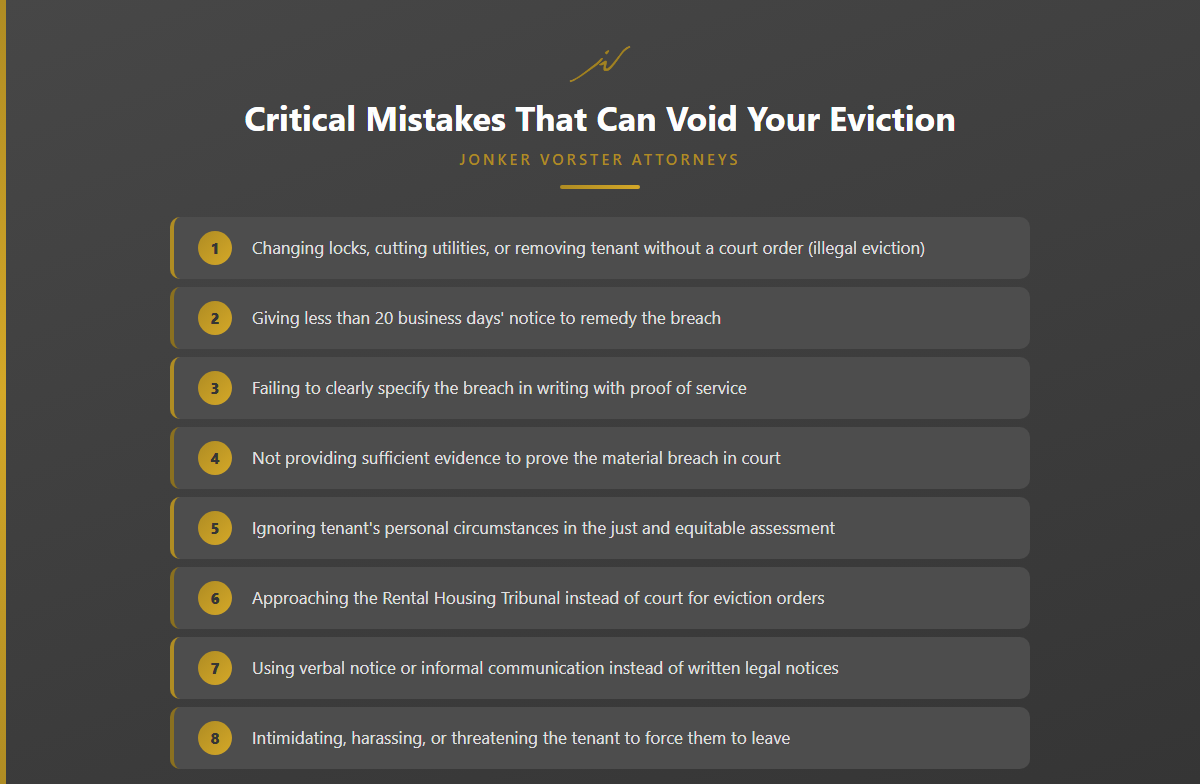
Any attempt to evict a tenant without a court order constitutes illegal eviction. This includes:
- Changing locks while the tenant is absent
- Cutting off electricity, water, or other essential services
- Removing the tenant's belongings from the property
- Physically forcing the tenant to leave
- Intimidation, harassment, or threats
Section 4 of the PIE Act makes illegal eviction a criminal offence punishable by imprisonment of up to two years. Tenants can also apply to court for a spoliation order (an urgent interdict restoring them to possession) and claim damages for unlawful eviction, alternative accommodation costs, and legal fees.
We have seen landlords face criminal charges and substantial financial liability for actions they believed were justified. There is no shortcut. Follow the legal process.
Insufficient or Defective Notice
Failing to give the tenant adequate written notice, or serving notice that does not comply with the requirements of the Consumer Protection Act, will invalidate your lease cancellation. Courts will not grant an eviction order if the tenant was not properly notified and given a fair opportunity to remedy the breach.
Common notice errors include:
- Giving less than 20 business days to remedy the breach
- Failing to specify the breach clearly
- Not providing proof of service
- Using only verbal notice or informal communication
Failing to Prove the Breach
The landlord bears the burden of proving the material breach. If you cannot produce evidence (such as payment records, photographs, correspondence, or witness statements), the court may refuse the eviction order.
Ignoring the Tenant's Circumstances
Courts take the "just and equitable" test seriously. If you fail to address the tenant's personal circumstances or simply ignore them, the court may refuse the eviction or impose conditions (such as extended time to vacate).
In practice, landlords who engage constructively with tenants, offer reasonable repayment plans where appropriate, and demonstrate that they have considered alternatives are more likely to obtain swift eviction orders.
Confusing the Rental Housing Tribunal with Court Eviction
The Rental Housing Tribunal resolves disputes between landlords and tenants and can issue rulings on unfair practices. However, the Tribunal cannot grant eviction orders. Only the Magistrate's Court or High Court can issue an eviction order.
Some landlords approach the Tribunal first, believing it is faster or cheaper. While a Tribunal ruling may support your case, it does not replace the need for a court application if the tenant refuses to vacate. Approaching the Tribunal can add months to your timeline without advancing the eviction.
Eviction Timelines and Costs in the Western Cape
Cost Considerations
Eviction costs vary depending on whether the matter is contested, the complexity of the case, and the attorney's fee structure. Typical costs include:
- Attorney's fees for preparing the application, attending court, and liaising with the Sheriff
- Court filing fees (relatively modest but vary by court)
- Sheriff's fees for service of documents and execution of the eviction order
- Additional costs if the matter goes to trial (counsel fees, expert reports, witness expenses)
In our litigation practice, we offer phased billing options for eviction matters, allowing landlords to manage costs effectively. Uncontested evictions are significantly cheaper than contested matters.
It is also important to budget for lost rental income during the eviction process. If a tenant stops paying rent and the eviction takes six months, that is six months of lost income that you are unlikely to recover unless you pursue a debt recovery claim and the tenant has assets or employment.
Western Cape-Specific Considerations
In the Cape Winelands region, including Paarl, Stellenbosch, Franschhoek, and Wellington, there are additional considerations:
Wine estates and farm properties: Evictions involving agricultural workers or farm dwellings may fall under the Extension of Security of Tenure Act 62 of 1997 (ESTA), which provides additional protections and requires a different legal process. If you own a wine estate or farm property, consult an attorney before proceeding.
Sectional title schemes: Evictions within sectional title schemes may involve the body corporate, particularly where the tenant breaches conduct rules or causes nuisance to other owners. Our levy collections work often intersects with eviction matters in these contexts.
Sheriff service areas: The Sheriff of the High Court Western Cape and Magistrate's Court Sheriffs serve different areas. Ensuring the correct Sheriff is instructed avoids delays.
When to Instruct an Attorney for Tenant Eviction
While it is technically possible to conduct an eviction yourself, the process is complex, highly technical, and unforgiving of errors. We strongly recommend instructing an attorney experienced in eviction law from the outset.
An Attorney Can Help You:
- Draft legally compliant breach and cancellation notices
- Gather and organise evidence to prove the breach
- Prepare the court application and supporting affidavits
- Ensure proper service of all documents
- Represent you at the court hearing
- Instruct the Sheriff and oversee execution of the eviction order
- Defend against tenant counterclaims or spoliation applications
- Navigate the "just and equitable" test and address the tenant's circumstances persuasively
In our experience handling evictions across the Cape Winelands, matters where landlords attempted to manage the process themselves frequently result in procedural errors, delays, and wasted costs. Professional legal assistance from the start saves time, money, and stress.
If you are facing a difficult eviction, contact our litigation team for a consultation. We will assess your situation, explain your options, and provide a realistic timeline and cost estimate.
Frequently Asked Questions
No, you cannot evict any tenant or occupier in South Africa without a court order. Section 4 of the Prevention of Illegal Eviction from and Unlawful Occupation of Land Act (PIE Act 19 of 1998) makes it illegal to evict without following due legal process. Landlords who change locks, cut utilities, or physically remove tenants face criminal prosecution and imprisonment of up to two years, as well as civil liability for damages and the tenant's alternative accommodation costs.
Uncontested evictions typically take three to six months from issuing the breach notice to the Sheriff executing the eviction order. Contested evictions, where the tenant defends the application, can take nine to eighteen months or longer, depending on court backlogs and the complexity of the case. In the Western Cape, Magistrate's Court delays currently add approximately four to eight months to trial scheduling in contested matters.
Lease cancellation is the termination of the rental agreement, typically requiring 20 business days' written notice for breach under the Consumer Protection Act. Eviction is the court-ordered physical removal of the tenant if they refuse to vacate after lawful cancellation. You cannot evict without first lawfully cancelling the lease and obtaining a court order. Cancellation ends the contract; eviction enforces your right to possession.
Yes, non-payment of rent is a material breach of the lease agreement and valid grounds for eviction. You must issue a written breach notice giving the tenant at least 20 business days to pay the arrears. If they fail to pay, you can cancel the lease and proceed with eviction proceedings under the PIE Act. The court will assess whether eviction is just and equitable, considering the tenant's circumstances and the seriousness of the breach.
The Rental Housing Tribunal handles rental disputes and unfair practice complaints but cannot issue eviction orders. Only the Magistrate's Court or High Court can grant an eviction order. Some landlords first approach the Tribunal for a ruling on unfair practice before proceeding to court, but this is not mandatory for eviction. If your goal is to remove a tenant from the property, you must apply to court.
Illegal eviction is a criminal offence under the PIE Act. You can be imprisoned for up to two years, fined, and ordered to pay damages to the tenant. The tenant can apply for a spoliation order (an urgent interdict) restoring them to possession, and you may be liable for their alternative accommodation costs, legal fees, and any other losses they suffer. Illegal eviction can also result in your eviction application being dismissed, forcing you to start the process again.
Conclusion
Evicting a tenant in South Africa is a legally complex process that requires strict compliance with the PIE Act, the Constitution, and procedural rules. You cannot take the law into your own hands. Following the correct procedure protects you from criminal liability, civil damages, and costly delays.
The process involves issuing written notices, cancelling the lease, applying to court, attending a hearing where the court assesses whether eviction is just and equitable, and having the Sheriff execute the eviction order. Uncontested evictions take three to six months; contested matters can take well over a year.
At Jonker Vorster Attorneys, we regularly handle eviction matters in Paarl Magistrate's Court and Cape Town High Court. We understand the procedural requirements, the court's expectations, and how to present your case persuasively while respecting the tenant's constitutional rights. If you need to evict a tenant, contact us for a consultation. We will guide you through the process step by step and protect your interests.
This article is intended for general informational purposes only and does not constitute legal advice. For advice specific to your situation, please contact Jonker Vorster Attorneys directly.